
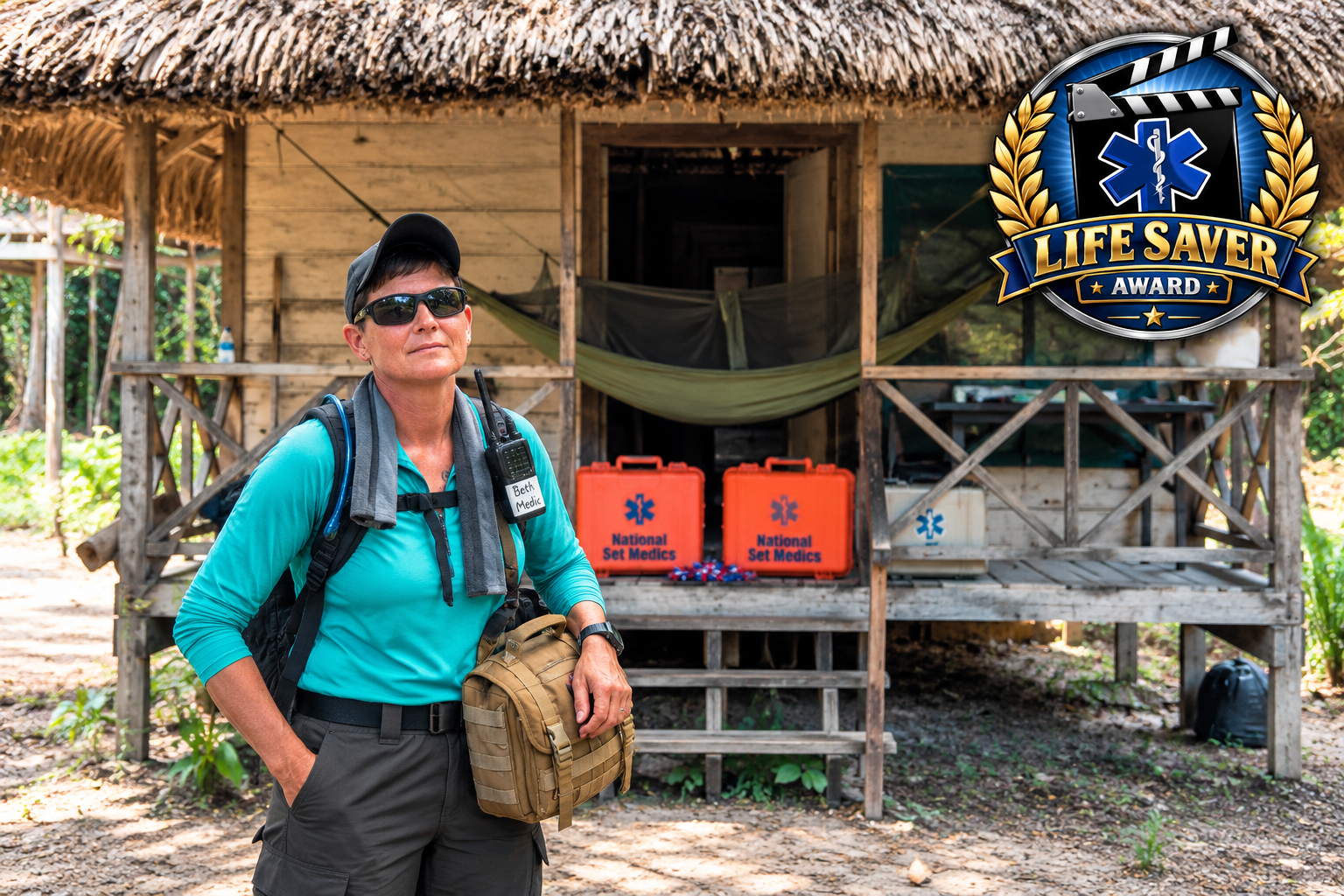
An unexpected medical emergency deep in the Guyanese rainforest
By Elizabeth Hammons, CCP-C | Director, Reality Medic Division, National Set Medics
Rewa, Guyana | August 11, 2018
The heat in Guyana was relentless. Even after the sun went down, the humidity hung in the air, thick and heavy. We’d been working in the remote interior of South America on a production of Naked and Afraid, operating out of Rewa Eco-Lodge along the river.
I’d strung my hammock across the porch of my little hut, hoping to catch whatever breeze the night might offer.
Sometime that evening, two Amerindian men appeared out of the darkness carrying flashlights.
They needed medical help.
A boy in their village had been bitten by a labaria snake, a venomous pit viper found throughout the region. He wasn’t doing well, and they wanted to know if I would come.
I notified our producer, and production manager, that I was going across the water and asked them to arrange for our local fixer to join us.
Then I climbed into a small boat with the two men.
We traveled around to the other side of the island, where most of the local community lived. The village was small, home to perhaps 300 people. When we arrived, they led me into a concrete building with very little lighting.
The boy was lying inside.
I remember looking up and seeing faces crowded around the outside window, everyone watching.
He was somewhere around 12 to 14 years old. He’d been bitten on his foot hours earlier. The villagers initially believed he would recover without significant intervention, but his condition had deteriorated.
His foot was markedly swollen, extending into the ankle. He was in considerable pain.
What concerned me most wasn’t the swelling.
He was bleeding from his gums.
In the setting of a pit viper envenomation, spontaneous bleeding raises immediate concern for a serious venom-induced coagulation disorder. This wasn’t a situation where we could simply watch and hope for improvement.
I brought the local healthcare provider over and showed him what I was seeing.
The boy needed stabilization and evacuation to a facility capable of providing definitive treatment.
We were hours from conventional medical care, in a remote river community, at night.
I arranged for my medical equipment to be brought over from the eco-lodge and began treating him with the resources available.
My immediate priorities were maintaining hemodynamic stability, managing his pain, addressing the inflammatory response, and providing supportive care while we worked to arrange his evacuation. I immobilized the injured foot, established intravenous access, and began fluid therapy. I also provided antibiotic therapy and symptomatic treatment, continually reassessing his condition for signs of further deterioration.
There was no definitive treatment for the envenomation available to me in that village. Everything I did was aimed at supporting him and buying time until we could reach a higher level of care.
Meanwhile, our local fixer worked with Ian, an experienced former British Special Forces operator who helped coordinate our remote operations, to arrange an aircraft.
Getting an emergency medical evacuation in that part of Guyana was difficult under ordinary circumstances. Doing it at night presented an entirely different set of challenges.
Eventually, we were able to move the boy by johnboat, traveling approximately an hour upriver to an aircraft pickup location.
He remained conscious during the journey.
From there, he was transferred for a flight into Brazil, where he could receive further medical treatment.
I didn’t accompany him on the aircraft. I was still assigned to our production.
For a while afterward, I had no firsthand knowledge of how he was progressing.
Then word came back that he had survived and was returning home.
What I hadn’t known during the emergency was that this boy was the son of one of our local guides.
The night before we departed Rewa, his father presented me with several handcrafted gifts. One was a ring carved from a kukrit nut, from a palm he described as the Tree of Life because of the many ways his community used it.
He also made me a traditional four-foot bow. The boy’s grandfather made another, approximately six feet long.
And his father gave me a black caiman tooth, explaining that in his culture it was believed to offer protection to women.
I don’t remember his exact words. But I remember the gifts, the care with which they had been made, and what that exchange meant to me.
As our team was leaving Rewa, I caught sight of the boy again.
He was out fishing with his father.
I’d already heard that he’d returned home, but I hadn’t realized he was doing so well. After remembering him lying sick in that dimly lit building, with the villagers watching through the window, it was remarkable to see him back on the water.
I never got the opportunity to speak with him again.
There was no dramatic reunion.
Just a father and his son, fishing.
And of all the things I remember about that assignment, that ordinary scene is one of the things that has stayed with me.
Sometimes the most meaningful part of a medical response happens long after the emergency is over.
Sometimes it’s simply seeing someone get to go home.
-Elizabeth Hammons, Director Reality Medics® Division
Watch her interview with 59 news here: https://www.youtube.com/watch?v=a8Hs0EqdgbM
Recent Comments